We’ve been thinking heavily about how the principles of motivation and behaviour can inform strategies for remote teaching. This is what we’ve come up with….
Remote Learning Behaviour and Pastoral Scripting
We’ve been thinking heavily about how the principles of motivation and behaviour can inform strategies for remote teaching. This is what we’ve come up with….
Remote Learning Behaviour and Pastoral Scripting

Attendance is crucial to any school. It doesn’t matter how amazing your lessons are if students don’t make it through the front gate. Of course, quality of teaching in itself impacts upon attendance, but it is safe to assume that a huge number of factors affects where or not a pupils comes to school. This can be no more true than during our current situation as we navigate through these unprecedented times. But, we need students in our online lessons…. not just for the pupils, but for the teachers too.
The rationale for prioriticising attendance may be obvious; it can be explained as follows:
Attendance and access to online learning is also inequitable. Poorer pupils are the victims if this does not go well. Even if this isn’t a given, quite simply put, the barriers to attending online lessons for pupils from low income backgrounds are greater than their wealthier peers. This is not a secret, even beyond the realm of EduTwitter. Indeed, a recent New York Times article reporting anecdotal reflections of teachers across the USA made the following claim:
I’m sure this image will be familiar to us all. Ultimately, between Autumn 2018 and Spring 2019, when schools are operating in a more familiar setting, the average national absence rate of children eligible for Free School Meals was 7.2%, in comparison to the 4% average absent rate of students who were not entitled to this. Indeed, disadvantaged students were more than twice as likely to be Persistent Absentees. It is hard to believe there will be a monumental shift in this during these times of uncertainty and societal crisis.
I spent a bit of time thinking about the current barriers that we have seen at Oasis Academy South Bank to pupils attending online lessons.

The above barriers to online lessons (by which henceforth I am referring to sessions delivered by a teacher that pupils access via an online platform) are in no means exhaustive. Nor are they the most significant; they are simply reflections from experience at Oasis South Bank. Nonetheless, thinking about these made me realise that the vast majority of barriers to attendance are not unique to online learning. Yes, those related to technology are fundamental barriers at this time and certainly more prevalent than before. But, many of the other reasons for absence are the same as when lessons physically took place at school. When delving into this further, we can also see a positive correlation in absenteeism from online lessons and previous absenteeism from school. Today, of the students in our Year 10 cohort who missed at least one online lesson, 38% were Persistent Absentees prior to the closure of schools. This is one of the most important attendance learning points:
The true barriers to a child attending online lessons are not new. They have been exacerbated by the current situation, but the trend remains the same; if a student was less likely to attend school, they are equally less likely to attend online lessons.
So, we must delve deeper than deeming ‘not being able to log on’ as the primary barrier to attending online lessons. We must ask, why hasn’t the pupil logged on? Often the answer has nothing to do with technology.
At Oasis South Bank, we have set up a system to improve attendance online. We have made changes along to way to refine the approach follow some pitfalls that we encountered:
Over the last couple of weeks we have worked hard to ensure all of our students are able to access online lessons and do so consistently each week. Before even thinking about the ‘day-to-day’ attendance procedure, we asked ‘can all students actually access the lessons?’
The set up
At Oasis South Bank, we believe in shaping the path for our pupils. To do this we took some inspiration from Nudge Theory. As a recent post by Durrington Research School states ‘This theory proposes that positive reinforcement and indirect suggestions, are more effective as ways to influence the behaviour and decision making of groups and individuals’. We gave students these little nudges before online lessons even began. Students’ were given a ‘challenge’ to send an email to their House Coach, we reset passwords for any student who had forgotten, we gave laptops to students who were without them at home, we gave out physical workbooks so that we could have the time to perfect(ish) our online teaching without the students disengaging from learning. By investing in the set-up, we made the first step easier. In a fantastic blog, Harry-Fletcher Wood argues that it is crucial to ‘make it easy’ in order to motivate students to join online learning. We thought about the ingredients needed for a student to access learning online and mapped it out for them, step by step. Finally, before logging on the students were given a ‘Ready to Learn’ challenge that incorporated practice of the main features of the online platform that we are using, Microsoft TEAMs. By phrasing it in this way, we prompted students to make the right choices, using a little ‘nudge’ by calling the tasks challenges! Now we knew students could access the platform, but that didn’t mean they would attend lessons! For this, we needed an absentee procedure.
The System
At Oasis South Bank, we have designed and implemented a simple system to reduce absences in online lessons. This is based on four stages: buy-in, recording, response, and intervention. Crucially, the system is not particularly different to our usual procedures at school. (In this super Twitter thread, Chris Wardle outlines his experience of how to improve attendance- it is definitely worth a read)
Buy-In
Like in school, motivating students is crucial to promote attendance in online lessons. We have used online assemblies and micro-scripting to this. Even before the lessons began, we used positive-messaging in emails to students to promote engagement.
Dear students,
I am excited to start our lessons next week!
To make sure that we are ready, you will shortly need to complete the South Bank Ready-To Learn-Challenge. Be prepared to receive an email about this on Friday morning. You will have all of Friday to complete five important challenges!!!
Once you have done this, you will be ready to learn!
This communication is crucial. Once again referring to Harry Fletcher-Wood’s blog, it’s important to develop prevalent norms that students understand; we made them not want to ‘miss out’. Even at the beginning of lessons we continue to share these prevalent norms. In CPD, with have micro-scripted personal and social motivations for the beginning of the lesson that may sound like: “While schools are shut, the requirements of universities and jobs have not changed. You still need to be learning, even if you cannot be in school. This is why these lessons are so important for your future.” (Personal Motivation) or “Last lesson, every single student in our class was logged and learning. Like you, they realise how important it is not to be left behind.” (Social Motivation). Without creating a prevalent norm among our students that online learning is important, the rest of the attendance system would not work.
Recording
Again, this is a simple procedure. Rather than teachers completing an individual register, this is done centrally. The teacher simply emails the names of the students who are absent from their lesson to a member of the admin team, who updates a shared spreadsheet. There are a number of benefits to this:
Response
We know that the more timely the response is, the more effective it will be. We place heavy focus on the first lesson of the day; ensuring students have attended this first online lesson shapes the path for them to then join the rest. Again, it’s a high leverage ‘nudge’. We use ‘Attendance Warriors’ for the first period of the day. This is a simple procedure. Each year group has an assigned member of support staff that calls home for any student that has not attended their first lesson. Teachers email names of absentees straight to the ‘Attendance Warrior’ who calls home straight away and then updates the centralised register to record this. This has a really positive affect as it is early intervention. Instead of waiting till the end of the days, or even the end of the lesson, a phone call is made home and in most cases the student attends the lesson, and therefore also attends the remaining lessons that day. To reduce workload, we only ask Attendance Warriors to make calls during the first lesson. We have identified this as the period with the high impact, and focus on this. Students that missed subsequent lessons are still followed-up, but this is through a staged intervention process.
Intervention
At 14:30 every day we review the register and filter the number of absences during the day. This is quick and simple because the register is a centralised and shared document that has already been populated using a drop-down menu with subject names. As you can see below, the document has a section that allows the member of staff leading on attendance to select an intervention also using a drop-down menu.

The interventions are selected in a flexible way that is loosly-based on the following:
Currently, we have evaluating how effective this intervention system is. The purpose of it is to avoid multiple teachers making the same phone call, and show a consistent escalation procedure. However, phone calls alone may not be effective; South Bank has an incredibly skilled Pastoral Team who use their professional judgement well to work out the best way to reduce the barrier to a pupil’s attendance, and constant communication between staff allows for this more fluid method of intervention. However, this could be systematised to include attendance trackers, more formal ‘online meetings’ with parents, IT support, texts/emails to students etc.
Over the last four weeks, we have learned a great deal about attendance, but if anything we’ve learned that those barriers that were there before are still there now, and have been further exacerbated. But, we cannot leave students behind. Effective ‘set-up’ and a strong attendance procedure based on student ‘buy-in’, simple recording, swift response and well-planned intervention is crucial to boosting numbers of pupils on the other side of the screen!
Next, we want to think about using rewards more effectively… ideas welcome!

This blog is the first in a series on achieving outstanding behaviour. In what follows, I shall explore the importance of consequences in schools and how sanctions should be used to achieve outstanding behaviour.
Between August 2010 and August 2018, the percentage of schools graded to be Good or Outstanding increased from 66% to 86%; there are now 1.9 million more children in Good or Outstanding schools than 8 years ago. However, I have a hunch that far more than 14% of schools in the UK are typified by ‘bad’ behaviour. Despite the Ofsted validation, more recent surveys found that 42% of teachers admit to be on the receiving end of verbal abuse, and 24% disclose that they have been physically threatened. Furthermore, the DfE have highlighted pupil behaviour as a factor contributing to issues with teacher retention. Unfortunately, despite improvement in Ofsted grades, it is now commonly thought that a ‘behaviour crisis’ exists in British schools.
But, some schools have managed to create outstanding behaviour among their students. At this point, I want to make clear what it mean by schools with ‘good’ and ‘bad’ behaviour. For the purpose of this blog, schools with ‘good’ behaviour experience the following as the norm:
Ultimately, at schools where behaviour is outstanding, the above is homogeneous and consistently observable.
It is important to note that all schools will experience ‘bad’ behaviour; the difference in schools with ‘Outstanding’ behaviour is that this poor behaviour is dealt with effectively and therefore the criteria above is upheld as the norm.
At Oasis Southbank, student behaviour is Outstanding. According to Ofsted:
‘Behaviour and safety are outstanding. Students have a strong work ethic; their social responsibility and pride in the Oasis community are particular strengths.’
Beyond this, students and carers highlight the ‘strict’ and ‘warm’ elements of the school, which are often the reason cited by parents for choosing to send their children to Oasis Southbank. Of course, there are other schools with Outstanding behaviour.
A very recent Ofsted Report for The Totteridge Academy suggested:
‘Leaders and teachers manage pupils’ behaviour exceptionally well. They have a clear
and consistent approach to supporting pupils, which is understood by all staff. Leaders
continually encourage respect for self and others. This results in a harmonious and
peaceful learning environment. Pupils’ strong relationships enhance learning.’
Furthermore, the Ofsted Report for Dixons Trinity Academy, which is in the top 3 schools for Progress 8 score states:
‘The behaviour of students is outstanding. All staff and students fully understand and uphold the academy’s values and, as a result, behaviour in lessons, around the academy and towards their peers and other adults is exemplary.’
Other schools also have Outstanding behaviour, and this can be achieved in very different ways. But all have two things in common. First, they seek to establish explicit routines and habits based on high expectations. And second, all staff at the school hold students to these with the same level of consistency.
If these two foundations of excellent behaviour falter, the likelihood is that poor behaviour will become the norm in school. Imagine a rugby match (I pick rugby because football is not the best example!) without a yellow or red cards; imagine a yellow line without parking tickets. Without these sanctions, there is an ability to opt out of the rule, which is universally beneficial. Unfortunately, for a number of different reasons, these are the first two parts of behaviour management that experience system failure. Either, the leadership have not thoroughly thought of school-wide routines, or certain members of staff (often including leadership) do not hold students accountable to these expectations. Therefore, consequences are crucial to achieving outstanding behaviour.
Recently, Twitter has seen a debate over the use of consequences in school, with many people advocating that consequences create an exclusive education system and lead to generational dissatisfaction with schooling. However, consequences are not just sanctions, as Tom Bennett outlined in a very useful thread. They can also include rewards, one-to-one conversations, parental meetings etc. Therefore, a consequence should be seen as the result of a certain behaviour, which can also be positive. Nonetheless, this should not undermine the importance of sanctions. While this may be received in a controversial way, there should be no doubt that punishment is a necessary part of establishing outstanding behaviour. Nick Rose’s suggests that sanctions in societies of high trust are highly effectively. Therefore, sanctions can be both the cause and product of strong relationships between teachers and pupils. The view of school punishment has, however, been misshaped to advocate some oppressive form teacher control; a modern concept of Victorian respectability and humiliation. This cannot be further from the truth. Yes, at Oasis Southbank, we have sanctions. Yes, at Oasis Southbank, students are punished. But this is never done in a harmful way and is always carried out with the students’ best interest in mind. Ultimately, consequences, including sanctions, are in the pupils’ best interests, even if they do not understand that at the time.
So if consequences are necessary, how can they be used effectively? First, let’s think about how they are used poorly and examples of ineffective implementation:
(These are not an exhaustive list of examples, and some are more appropriate than others. I recognise that even in schools with Outstanding behaviour, the above can take place at times. The point is that these are the main ways that consequence are implemented in ineffective way. There is also the problem of no consequences- in other words, the school simply does not follow-up with holding students accountable to the rules that they should be following).
At Oasis Southbank our sanctions work because they are:
The most important part of this is that sanctions are certain and we NEVER undermine other members of staff.
To establish this, the following school-wide strategies are utilized:
Outstanding behaviour requires sanctions. A rule is not rule if there are no consequences for those who break it. Of course, there are times where our pupils find it frustrating or disagree with us; but, when they leave the school, even the most challenging thank us for the consequences that we gave them because they realised it was for their own benefit. Sanctions are not an end in themselves; instead they serve a purpose. And I for one think that purpose is more important than ever!

It’s 10:07. Lessons started 7 minutes ago. Some pupils are in classrooms, many are still on the corridor. Those still in the corridor are talking, quite a lot are shouting. Some students are walking to their lessons, some are dawdling; many are running in the complete wrong direction. The disruption on the corridor percolates into my class. Instructions from staff are ignored. The corridor is a frenzy of socialising and distraction at best; at worst it’s an uncontrolled and unsafe state of chaos.
Unfortunately, for many teachers in the UK, the above is the norm.
Over recent year, many schools have taken action solve this issue: creating a policy of ‘silent corridors’. In other words, while students walk on the corridor between lessons, breaks, and lunch, they must do so in silence. They may talk in areas where they have their lunch and break, but not until they reach this space.
The reasons for this rule are simple:
By enforcing silent corridors, disruption in transition is completely minimised and pupils are very clear of what is expected of them; their is no discrepancy between students and adults.
While, I am in no way suggesting that all schools should adopt such a policy, I am concerned that much of the media’s representation of it is completely misguided.
Since the announcement made by Ninestiles in Birmingham that corridors in the school will become silent, the media has sensationalized this policy in order to promote a misplaced rhetoric that schools are overtly interested in establishing authoritarian control over students lives in a repressive manner, thus stifling the apparent ‘freedom’ of undisciplined behaviour. Indeed, tweets have filled my timeline that compare the policy of silent corridors to the conditions in Concentration Camps under Hitler’s regime. Not only is this incredibly insensitive and offensive, it is complete mistaken.
The comparison that the media so often makes between educational discipline and educational authoritarianism is a lie. No teacher or school leader creates policies like that of silent corridors as a manifestation of a habitual intention to oppress. Despite this, a Guardian article released today stated that: ‘It is difficult to think of a more harmful and mean-spirited policy than taking away children’s means of communication for a significant part of the day.’ However, I can certainly think of far more harmful consequences that the absence of such a clear and sensible policy creates. Moreover, with a “severe shortage” of teachers in the profession and over 50% of NQTs considering leaving the profession as a result of, alongside workload, poor and challenging behaviour, the harm that disruptive and dangerous corridor conduct creates goes beyond the schools where this takes place. Indeed, a thread on Edutwitter indicated the intolerable behaviour that teachers have experienced on the corridor from letting of fireworks, to barging past adults; the small and distracting chat is not the only problem, it’s what escalates from it.
Furthermore, arguments from the media that silent corridors focus on assumptions regarding learning and what pupils ‘like’. It’s all anecdotes based on ‘when I was at school…’. This is a disastrous way to lead education. Yes, everyone has an insight to education. Yes, everyone is a stakeholder and their opinions matter. But, the experts on school leadership have had their voices hidden by the media. Indeed, Tom Bennett, made it clear that ‘attention to detail’, ‘consistent practices’, and ‘detailed expectations’ created positive impacts on school culture which ultimately led to improve academic attainment. Furthermore, when investigating progress measures, it is clear that where more disciplined policies are embedded, higher results are achieved. Indeed, Dixon Trinity Academy has a P8 score of 1.57, Magna Academy in Poole achieve a score of 1.04, and Oasis Academy Southbank’s was 0.92. These schools, in very different locations, all have silent corridors. Far from ‘harming’ their pupils, as many in the media suggest, these schools have a far higher than average number of disadvantaged students on roll and these students generally achieved at least one GCSE grade above in every subject than they would have scored in the average school in England. This is not to say that these schools gained their results because they have a silent-corridor policy, but it is indicative that discipline is far from harmful; it create freedom for students who would have been previously shackled by educational inequality.
Ultimately, this policy is a choice for schools to make. Let those who have the integrity and knowledge to make such decisions do so without unfounded attacks seen in the media. This isn’t a political issue and it doesn’t need to be one. While the media may want you to picture a prison-like system liken to a scene from a Roald Dahl novel, the truth is that students are happy in school with boundaries and high expectations. If you don’t believe me, come and see for yourself!

Across all subjects, depth and breadth of content at KS4 has increased. Students are simply required to remember and apply more knowledge to secure good grades in their GCSEs. For many schools, the answer to this has been simple: allocate more time to subjects by increasing KS4 from two years to three years. The motive behind this also follows a straightforward premise: more time spent studying the subject means that students can cover more content and thus make more progress.
In my mind, this premise, in itself, is utter rubbish!
I should clarify, this blog is not to refute the principle of allocating three years to KS4. Rather it is to argue that this ‘silver bullet’ will not alone improve students’ learning for a number of reasons:
In preparation for the new three year KS4, today our History department created a curriculum that focused on spaced-practice and retrieval. It is important to note that we chose to re-assess our understanding of curriculum models to move away from the idea of ‘coverage’ and towards a ‘narrative‘ (Christine Counsell talks at length about this in her recent blog). This mainly built on ensuring links between KS3 and KS4 to ensure that students learned content for both the purpose of understanding the concept in itself, and also to enable further understanding of subsequent concepts. For example, in Year 7, pupils master understanding of the terms ‘vestments’, ‘vernacular’ and ‘Puritan’ to plant the roots in preparation for studying Elizabeth’s Religious Settlement at GCSE.
Furthermore, we developed strategies to promote retrieval through three formats: in lessons, in assessment, and in revision.
What does spaced-practice look like in lessons?
All topics have a knowledge organiser. These have been blogged about consistently in recent years, however they should not be used as a ‘panacea’. Rather, as Michael Taylor advocates, they are ‘tools’ for teachers. We use knowledge organisers as a basis for what students are expected to know; but they are used in all lessons, every lessons. When students enter the class the Do-Now is always: ‘Revise and self-quiz the following aspect of your knowledge organiser’. At GCSE this will be on a topic previously studied. For example, figure 1 shows how a Cold War topic is used in a ‘Do Now’ in a completely separate unit. We purposefully mix-up the content that we test so that it does not follow any chronological or thematic pattern; this furthers retrieval practice by challenging students to recall knowledge out of context, thus simulating cognitive pressures in exams.

Modelling the habit of using their knowledge organiser is essential as many students found it easy to ‘opt out’ without clear guidance. We used the method advocated by Oasis Southbank in their revision strategy of ‘Look, Cover, Write, Check‘. Students complete this independently for the first five minutes of the lesson prior to the teacher verbally quizzing. Once embedded, this is a calm and meaningful routine that sets the tone for the remainder of the lesson.
What does spaced-practice look like in assessment?
Our History curriculum include a variety of different low-stake assessments, and lots of them! First we use Recap Tests, as shown below. These include multiple choice questions, chronological order quizzes and one extended answer to apply knowledge learned. This form of assessment draws on all topics that have been studied in order to promote retrieval. Furthermore, students also complete ‘mini-mock’ questions. These are completed without any teacher support or scaffolding and will be on any content studied within each sub-topic. By removing scaffolding students are forced to try to remember and apply evidence that they have learned; it tests how students perceive knowledge, and how they can make the content that they know relevant to the question.

What does spaced-practice look like in revision?
‘Nothing New, Just Review’ is not a novel idea. Rather it has been mentioned in blogs by Ben Newmark among others. However, in our new curriculum, we have sought to upscale this to interweave revision lessons into each term. For example, In the final term of American West, we revisit the topic previously to embed concepts that support the content being taught. These lessons simply start with 10 quiz questions, followed by an overview of the topic and key concepts within it, and ending with 5 questions from the quiz that was used at the start and 5 new questions. Consistently, all but a few see their scores increase dramatically demonstrating marginal gains which further motivate students to complete independent revision.
What next?
One of the key questions in spaced-practice is when is the best time to re-visit and assess topics that have been studied. Indeed, is a model of teach A, teach B, teach C; test A, B, and C better than a model of teach A, test A; teach B, test B, teach C, test C? While these strategies appear to be the most common, research suggests that they are not the most effective. Rather cumulative assessment appears to have most positive impact on retrieval. For example, to constantly revise content, teachers should teach A, test A, teach B, test A and B, teach C, test A, B and C. Indeed, in David Didau’s blog he notes that the model of study, test, test, test produces the most effective results. However, this is easier said than done.

Culture is fascinating. It provides the scope in which we operate. Social values predicate our actions and decisions. In keeping with my love for history, I recently read Histories of Nations: How Their Identities Were Forged. I was particularly intrigued by Dina Khapaeva’s dissection of Russian history. As Khapaeva suggests, Russia’s cultural past has been a reaction to the west. Russia, ever looking over its shoulder, was wary of, and motivated by, the moves of its imperial counterparts. Cultures therefore cannot be seen as isolated. They are interlinked, even if disparate. However, even more significantly, it is important to note that culture can change, and do so as values alter. In 1990, residents of Leningrad referred to two American presidents in their top five most admired statesmen. By 2007, these two US top-dogs had been replaced with an all-Russian top five, which included Stalin and Lenin.¹ Russian culture is coming to terms with its Soviet past. To this end, culture is defined by what is accepted and celebrated, and what is condemned and condoned.
As I’ve mentioned in a previous blog, Tom Bennett’s ‘Creating a Culture:
How school leaders can optimise behaviour’ revolutionised my understanding of behaviour in school, and how leaders can seek to achieve calm and orderly climates conducive to learning. While training, creating routines in my lessons was a priority, as it is with many teachers. I had to think about what way I wanted my pupils to enter the room, how I wanted them to contribute to discussion, and what they should do when I was talking. Now my routines are my bedrock. They are more than just the memorised habits of students in my class; they form the culture that I expect. Indeed, unless you create a culture and share the values of this, pupils will fill the void in a way that is less likely to be conducive to learning. Without expectations, there is just behaviour; who’s to say if it’s good or bad?
This year I decided to be even more explicit about these routines and, building on the behaviour policy at Dixon’s Trinity Academy, introduced the following ‘learning habits’. Clarity if key. The students know what to expect and know that I expect this because I care about them and their learning:

However, these are just my routines. In the classroom across the corridor another teacher has to decide their routines, and another teacher upstairs will form their own. Some will commit to routines. Others will allow them to fade away. How much easier would it be for me to teach my subject if I didn’t have to worry about how I wanted my pupils to line up for my lesson; what if this thinking was already done for me? Initially when I began teaching, I thought that autonomy was key (I still believe it is important). However, I had a misguided understanding of autonomy. I thought that teacher autonomy was about how they ‘ran their own class’. If we move away from this understanding of autonomy we can talk more about teacher’s pedagogy and practice, and the decisions that they can make to maximise learning in their classroom.
Routines are liberating, for pupil and teacher. But inconsistency cripples routine. In my observations cultures form in school in the following ways:
Consistency is key. In order to achieve a positive macro-culture, all teachers must follow the same system. It may seem dogmatic, but in reality it’s liberating. Rather than every teacher creating dozens of different routines, which students must adapt to every hour, this allows children to internalise the expectations of them. With consistency, there is no confusion, for both pupil and teacher. With consistency there becomes a positive culture.
¹Dina Khapaeva, “Russia: Fractures in the fabric of culture,” in Furtado, P, (ed)., Histories of Nations (London: Thames & Hudson, 2017), 17-32.

Last Saturday I had the privilege of attending the West London Free School History Conference. In its second year, the event boasted a fascinating array of speakers, all with a common vision: a knowledge-rich curriculum delivered explicitly by experts has a transformational affect on young people.
Below are my thoughts on the speakers that I heard and sessions that I attended:
Robert Peal (opening speech):
Rob had a very simple message to open the conference. He argued passionately that we must equip students with historical knowledge in order for them to develop an ability and desire to gain further knowledge. Weaved into a fascinating and humorous speech was references to Rob’s experiences in the classroom even in the earliest stages of his career. From this it was clear that he believes there is no ‘right’ curriculum. As he put it, there can be no ‘magic-bullet’ which will be exposed through evidence and research. The delegates resonate hum certainly professed their agreement, and set up a fantastic focus for the rest of the day: is there is not a ‘one size fits all’ curriculum, what can the history community learn from each other about modifying the way in which history is taught in different schools?
Michael Fordham (Can we accurately assess substantive concepts?):
This was the first session that I attended, and it did not disappoint. It was like stepping back into my undergraduate days, discussing history with those who also have a passion for it. In this active session, Michael presented different concepts that history teachers expected students to have mastered by the end of Key Stage 3. Revolution, Democracy, Papacy, it was a list a pure historical intrigue. The question raised was is it possible to assess these synoptically to gauge how good students are at history. Essay questions soon followed. How absolute are ‘absolute monarchies’?; How significant was religion in Holy Wars?; ‘Empires have improved the lives of all those within them’ How far do you agree? Challenging as these questions may be, there is clear value to assessing history students in this way. It encourages students to draw upon links throughout topics. Rather than studying a period, assessing students, and moving on, never to return, this provides pupils with the scope to be creative and discuss the narrative of the past in a more analytical way. Of course, the extent to which this could be successfully implemented remains unverified. It would be important to explicitly teach conceptual links between periods (but this would be a positive development in history teaching). Furthermore, the assessment of it may prove difficult considering often misled school-wide agendas on using GCSE grades at KS3. Despite these challenges, this forward-thinking is exactly what is needed in history teaching, and it was a pleasure to discuss this with Michael and other teachers during this session.
Ben Newmark (11 Principles of Great Explicit Teaching):
I make no apologies in admitting that this session was the one I anticipated the most. Ben’s blogs are nothing short of inspiring. Throughout my NQT year, these blogs have had the greatest external influence on my pedagogy. In listening to Ben, it was so clear to see that his attention to detail is phenomenal. Beginning by outlining that for the purpose of his session, ‘explicit teaching’ and ‘direct instruction’ may be used interchangeably, he then went on to discuss the ways in which this style can be used most effectively. Of the principles that Ben advocated, which can also be found on his blog-post, the one that struck the greatest cord with me was the second. Think about what you’re going to teach more than how you’re going to teach it. There can be no denying that teachers spend too much time thinking of gimmicks to deliver content. Instead of spending an hour writing, cutting and laminating sort-cards, teacher should devote this time to mastering subject knowledge and practicing explaining it. The latter will support students understanding and memorisation of content, the former will be remembered solely for the activity. Teaching will have come a long way when ‘less teacher-talk’ is no longer regarded as a staple in observational feedback. In fact, teacher-talk should be a regular feature of CPD, and Ben was explicit in arguing for this.
Ben Walsh (Interpretations):
Ben Walsh is an examiner, and his vast knowledge on interpretations was something to behold. In this session, Ben made it very clear that interpretations much be awarded the position that they deserve in history teaching. Interpretations are the bread and butter of history. They are the narrative that we teach, but how many children are aware that this narrative can be different? Therefore, as Ben argued, context is key. The agenda’s of the writers and periods in which they wrote predicate the content and argument promoted in their work. It’s about teaching the story or the story. And this requires expert knowledge on history, not just the past.
Christine Counsell (History Teaching Communities- Closing Speech):
Christine Counsell is a fountain of knowledge. There seems to be nothing that she does not know about history teaching. But what is so remarkable about Christine is the questions that she continues to pose. In this speech, Christine argued that leaders in education must provide scope for subject communities. These communities, whether they be school-based, trust specific, or across the subject are necessary for history teaching to flourish as a practice. Christine talked mostly about the responsibilities of history teachers in these communities. Of these, two have resonated with me in a most impactful way. First, it is our responsibility to make students aware that the account that we are teaching is not the only account. Linking very much to the arguments put forth by Ben Walsh, explicitly teaching different interpretations of history is a duty that we have. Second: read, read, read. We have the responsibility to keep learning from each other. There are some incredible pieces of work available to us, and it is our professional duty to immerse ourselves in these.
Final takeouts:
A fantastic conference, and one that I hope will continue. Leaving WLFS, I thought of a few general ideas that came across during the whole of the event:
As Robert Peal said in his opening speech, ‘history is philosophy teaching with examples’. We must educate students about historians, concepts, and ideas founded in rigorous historical knowledge.
Thanks to Louis Everett and all the team at WLFS for an inspirational day.

Everyone loves a story. Unlocking a world of interest, wonder, and fascination, stories are a cornerstone of human history. But, stories in the classroom go beyond a simple purpose of engagement; they unlock something even more meaningful: an understanding of rigorous content.
In Ben Newmark’s recent, and fantastic, blog-post on explicit teaching, one of the principles that he outlines is ‘unique story telling techniques’. However, Ben offers a caveat: ‘Be careful they reinforce- and not detract from- intended learning’. Though stories do captivate students, this should support conceptual understanding, rather than form further confusion as a result of gimmicks and over-performance.
Story-telling in the classroom has been in the firing line in the recent years. Even if not the intended target, the use of narratives in class has been criticised under a broad, and misguided, attack on teacher talk. As a History teacher, people often say to me, ‘well, it’s just one big story, isn’t it?’. In some cases, yes. However, throughout my time at university, I challenged the teleological understanding of the past. Nonetheless, to analyse the links between historic events and periods, an understanding of the story is necessary. As Olivia Dyer passionately notes, ‘Just tell em!’ Tell the students the story. Captivate them. Mesmerise them. But most importantly, inform them.
How does this look in practice?
I have separated Story-telling in the classroom into two general techniques:
Regardless of what type of narrative is being told, I have found that a number of techniques support students in their understanding of stories, and teacher’s in their delivery of these (This is not an exhaustive list, but merely initial observations):

I love telling stories, and my students love listening to them. But the purpose goes beyond this. Students recognise the importance of my stories because they realise that it helps them to understand content. Why should we hide this from students in order for them ‘construct’ knowledge? Teachers are continuously bemoaning the depth of content across the new GCSE curriculum; perhaps they have a point. But, efficiency of teaching is a valid determinant of effective teaching. If students can learn content substantially, without needing onerous periods of time, rigorous topics can still be taught in depth. Story-telling ticks these boxes, and I hope to become even better in my use of it.

Assessment for who?
‘Don’t write in green pen; it’s for them, not for us’: a comment that I overheard a student make when the teacher set up a feedback task. Cynical though it may be, the pupil had a point. Red pen for marking, green pen for response and redraft, black pen for written work. But for whom is the purpose of this?
Despite certain liberation through Ofsted’s lack of criteria on expected quantities, the term ‘marking’* conjures quite a uniformed descriptions from educators: tedious, stressful, arduous. Even in my short time teaching, I’ve lost count of how many occasions that I’ve taken a set of books home over the weekend only for them to remain stacked in my hallway, ready to return to my classroom in the exact same state that they left. Why, therefore, am I so reluctant to mark books?
1) A lack of accountability
2) Work load
3) Effectiveness and impact
As David Didau aptly writes, assessment and feedback are not the same. Indeed, while marking is a method of feedback, it is not always the most effective. There seems to be a misconception that because teachers spend so long marking, this type of feedback must inevitably achieve desired progress. If feedback to students’ written work is to be effective, schools must move away from misguided and vague systems that force teachers to constantly mark books. Instead, written feedback should be intertwined within a rigorous scheme of work, based on assessment that are unpinned by daily recap, weekly quizzes, and knowledge exams; these are referred to by Joe Kirby as the ‘Three Assessment Butterflies’.
For schools and teachers to design successful systems around feedback- as with any other strategy- the following questions are necessary:
– How effective and impactful will this strategy be?
– How will this reduce teacher workload?
– How will teachers, and students, be accountable for this?
As I mentioned previously, my marking this year has been poor. At the start of the year, eager to fulfill what I perceived was a vital role of a teacher, books were constantly marked. In an attempt to raise the confidence of students, comments along the lines of ‘Great effort, Sam! Keep this up!’ were begrudgingly written alongside a stamped happy face. Similarly, every student received a WWW and EBI, along with numerous content based questions sprawled throughout the pages that I marked. I bemoaned this method. Detesting the hours spent on marking books just for students to respond to questions like ‘which factor was the most important in causing the Atlantic Slave Trade’ with ‘The blue one’, it was clear that my time would have been better spent planning lessons, phoning parents, and improving my subject knowledge. Indeed, the opportunity cost of typical marking is too great.
Since then, I have tried a number different techniques, with inconsistent results. However, I have found the following strategies of feedback to be the most effective.
Feedback crib sheets:
Mr Thornton’s method of whole-class feedback revolutionised my practice. Below is an adapted version of his crib sheet that I use for assessment, and how a student has re-drafted as a result of this. When marking an assessment, students are given a next step code (e.g. NS2). Pupils then use the code to write out their next step target, which includes an example of how to improve their work in preparation for re-drafting. This form of modelling is essential. For NS2, if I had just written ‘Rather than describing the impact of a factor, focus on the extent to which Hitler can be blamed for starting WWII’ students would have struggled to understand how to demonstrate this in their re-drafted essay. However, with additional modelling in feedback, such as, ‘for example: “Appeasement was significant because… This suggests that Hitler was not to blame for WWII because…”, pupils are more likely to recognise how to achieve their next steps for progress, and successfully redraft their work.


Whole-class content based feedback:
Immediate feedback is powerful. Tackling a misconception straight away goes further in correcting errors than simply waiting for the next round of marking. After initial revision and self-quizzing of knowledge organisers, my lessons always start with a daily, knowledge-based recap, as shown below. This way I can provide feedback to the whole class straight away.

However, it is important to provide feedback on the written work in books. This does not mean that it is necessary to trawl through pages correcting every individual word that multiple students have all spelled incorrectly. As with Mr Thronton’s crib sheet, I look to establish common trends and provide feedback on these through whole-class revision and explanation. However, I also recognise that feedback for students will be different depending on how well they have grasped a certain concept. Therefore, in my marking, I simply place a code on the last page that corresponds to a certain target with a number of associated tasks. This way, my workload is minimal, yet students are challenged in feedback, and given the time to respond.

What next? Accountability and structure
Looking over the past year of teaching, inconsistency in my marking is glaringly obvious; some aspects were positive, others negative. In preparation for next year, I have interlinked my whole-class feedback and assessment feedback with schemes of work. For each topic, knowledge organisers will form the basis of necessary content that all students will learn and be assessed on. Using weekly knowledge quizzes, I will identify common errors, and use whole-class revision to rectify these. In books, I will be accountable for identifying errors and misconceptions, but the onus will be on students to correct their own work. Therefore, whole class modelling will be essential in feedback; this way, pupils will observe correct spellings and content, before looking through their own work in order to spot further errors and correct them. Like revision, it is important for students to learn how to self-edit, particularly considering they will not have the luxury of a teacher reviewing their answers in a GCSE examination, prior to submission.
In terms of assessment, I will provide more in-depth feedback on essays in preparation for re-drafting. Using the aforementioned crib sheet, students will respond to modeled feedback by re-writing their answers in order to demonstrate progress towards their target. Although I will be accountable for providing immediate feedback on assessments, thus promoting the relevance of the task, students will once again be responsible for improving their own answers as they will be accountable for using models and examples to support with their re-drafting of an essay.
Marking is a chore; feedback is uplifting. There is nothing more rewarding than taking a student from point A to point B, even when the route looks so challenging. Whole-class and low-stake assessment unlocks a new perceptive on marking. With less onus on the red pen, and more emphasis on learning, students will relish a new found sense of independence and accountability. Less marking ultimately means more, and better, feedback.
*I refer to ‘marking’, in the typical sense, as written comments made on answers completed by students in their books, or equivalent mode of evidencing schoolwork.

‘We don’t want them all to be robots!’, a comment I’ve heard numerous times from senior leaders. In schools, discipline is a concept shared with a significant amount of trepidation. It seems that an expectation for all students to follow all instructions all of the time conjures up ideas of dictatorial regimes and a police state. But why shouldn’t we expect students to do as they are told?
A normal break time interaction at our school, along with many others that I’ve seen, goes as follows:
Teacher: ‘Excuse me, can you pick that piece of rubbish off the floor please?’
Student: ‘No. It’s not mine.’
Teacher: ‘Yes, but you and your friends have used this area.’
Student: ‘So what? it’s not mine so I’m not picking it up.’
Teacher: ‘Okay, but it was one of you, so can someone pick it up please.’
(Chorus of students responds in attempts to refute said claim)
Teacher (beginning to become more angry or deflated): ‘Look can someone just pick it up please; we all need to do our bit. I even pick up rubbish.’
(Students walk away, litter left on the floor, with no sense of their wrong doing).
There are two behavioural problems in this example. First, the students were littering. Second, pupils have failed to follow the instructions of a teacher. In many circumstances it’s easy to ignore the latter problem, and focus solely on the former. However, the latter is equally telling of the climate of the school: defiance.
In many schools, behaviour is upheld for learning (for the purpose of this blog, I refer to learning as academic education). It is a means to an end. But, should we see it in this way? There is no doubt that outstanding behaviour is pivotal in achieving outstanding academic progress. However, when behaviour is seen only as a component part in learning, it means that perceived achievement of the latter can (and does) justify shortcoming in the former. Ofsted reports for schools where progress is ‘good’ rarely state that behaviour ‘requires improvement’ even though students are rude to staff, incredibly disruptive in class and fail to follow instructions. In other word, if students seem to be learning (often when they actually are not), their misbehaviour is justifiable. This should never be the case.
Tom Bennett’s report on Creating a Culture suggests that ‘good’ behaviour is not simply an absence of ‘bad’ behaviour. The choices that students make should not solely be seen in the context of learning, but instead as essential in the crafting of their character. For school to be successful in achieving this, three elements are essential: high expectations, consistency and support. I often ask students to think ‘what am I meant to be doing? Am I doing that?’ If pupils are to do this, they need to actually know what is expected of them. In many cases when I have seen a teacher lose control of a class, it not just because the teacher has low expectations, but rather they have no expectations; they haven’t actually thought about the way in which the students should be acting or what behaviour they want to observe.
After reading a blog by Stuart Lock, I was captivated by the use of ‘Learning Habits’ at Dixons Trinity Academy. Clearly outlining expectations for behaviour, students are aware of what is expected of them and why. Moreover, consistency in the application of high expectations is vital. Students crave boundary, and even more so, equity. Consistency means that everyone is treated the same, and therefore everyone is equally as valuable. However, there will be students who constantly fail to meet these expectations. In these cases, support should be given to these students. However, this support should focus on the decisions that students make, not on mitigating behaviour or lowering expectations.
But character means more than just avoiding sanctions. Below is an image used by Michaela to illustrate this point:
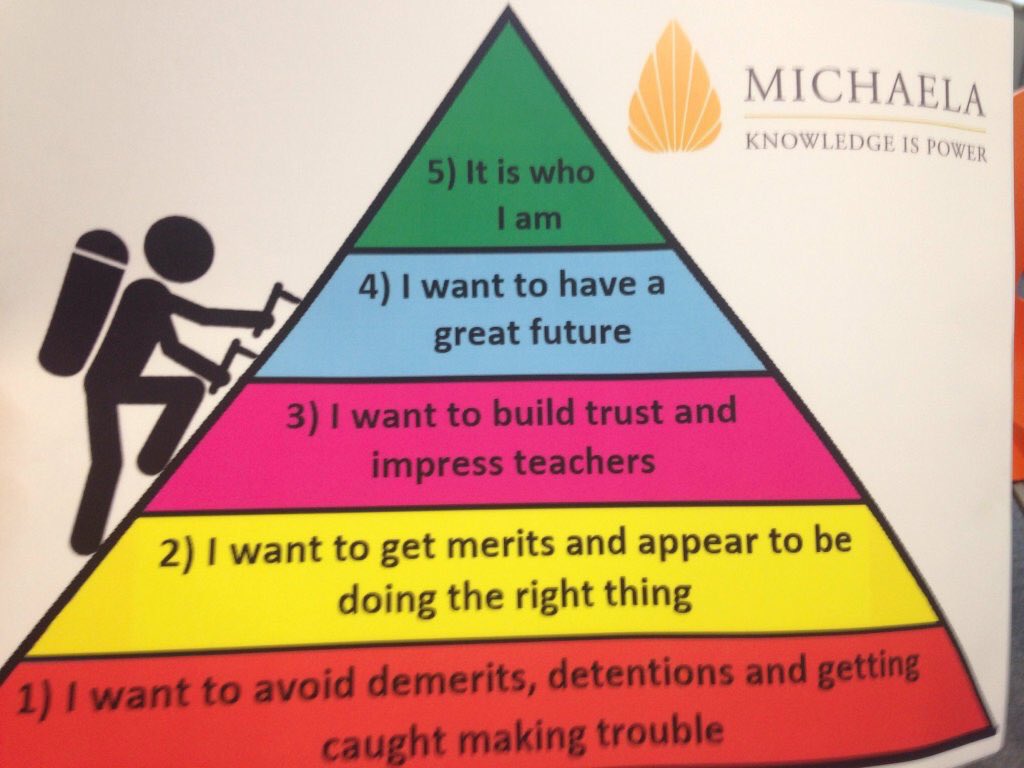
A behaviour crisis- though some still deny it- means that many schools fail to even embed the first rung of the pyramid. However, these systematic aspects of a behaviour system should not be overlooked. Sanctions and consequences are essential is a school is to remove low-level disruption. Nonetheless, in order to craft charactership, focus must move towards the top of the pyramid. Important as it is to separate misbehaviour from the individual, it is an eventual inevitability that the decisions a persons makes defines their character. Schools have a responsibility to act in a way that promote positive decisions in order to create positive characters.
As David Didau says ‘let’s seek to understand the reasons why poor choices are made, but let’s also refuse to accept these reasons as excuses.’ There can never be excuses. Reasons for poor behaviour may exist, but once teachers see these as excuses, they become insurmountable.
Behaviour is not for learning, it is for character.
 Notions from the classroom